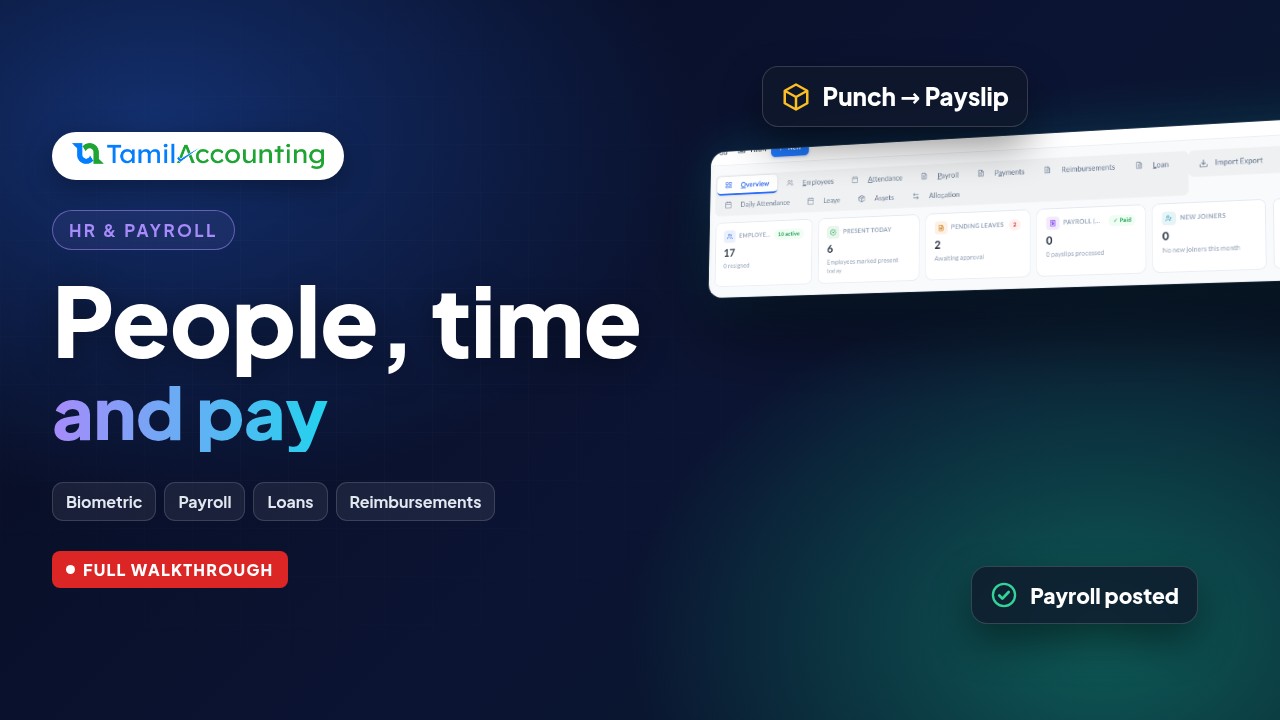
One module, the whole employee journey
Most small businesses run HR in pieces — a spreadsheet for attendance, a notebook for advances, a separate payroll tool that never quite agrees with the accounts. TamilAccounting's HRM module keeps the whole employee journey — hiring, attendance, leave, payroll, reimbursements, loans and company property — in one place, connected to the same books as everything else the business does.
A worked example
Priya joins the company as a site supervisor. Her employee record captures her department, designation, joining date, salary structure and bank account once. From that point on, every other screen in HRM already knows who she is.
Attendance, without a register
The office uses a biometric device at the entrance. Every morning and evening, Priya's check-in and check-out are captured automatically and imported straight into her daily attendance — present, absent or half-day, worked out for the whole team without anyone maintaining a manual register. On the rare day the device misses a punch, it can be corrected by hand for just that one day.
Leave that doesn't need chasing
When Priya needs two days off, she applies for leave against her available balance. Her manager sees the request, checks the balance for that leave type, and approves it — the decision is recorded on the request itself, and her attendance for those days reflects it automatically.
Payday, calculated and paid separately
At month end, payroll is processed for the whole team in one run. Attendance and approved leave already feed into it, so earnings, allowances, tax and any recoveries are worked out together, arriving at one net figure per employee. Processing the salary and actually paying it are two different steps — a separate payment, by cash or bank, is what moves the money and settles that payslip.
When work costs money out of pocket
Later that month, Priya pays for fuel and a client lunch out of her own pocket. She files a reimbursement claim with the amount, the reason and the bill attached. Once it is approved, it moves into the very same payment screen a salary does — reimbursements are not a side process, they settle exactly like anything else the company owes an employee.
A loan, recovered on its own schedule
When Priya needs to borrow against her salary, a staff loan is issued against a start date and a number of instalments. The system works out what should be recovered each payday, and the loan record shows exactly how much has come back and how much is still outstanding — no separate ledger to maintain by hand.
Every payment matched, every asset accounted for
Every payment the company makes to an employee — salary, reimbursement or loan instalment — is allocated against exactly what it settles, so nothing sits half-matched in the books. And when the company issues property to an employee — a laptop, a phone, a toolkit — that assignment is tracked back to the person holding it, separately from the company's fixed asset register.
None of this sits apart from the accounts. Payroll, salary payments, reimbursements and loan recoveries post to the general ledger the moment they happen, and the whole picture — payroll history, attendance summaries, leave summaries — is available as a report the moment management asks for it.
What HRM covers
- Employee records — department, designation, salary structure and bank details in one place
- Attendance, entered by hand or imported straight from a biometric device
- Leave applied for, approved, and tracked against a running balance
- Payroll processed for the whole team, then paid out as a separate step
- Expense reimbursements that settle through the same payment flow as salary
- Staff loans issued and recovered on a fixed instalment schedule
- Every payment allocated against exactly what it clears
- Company property assigned to and returned by employees, tracked separately from fixed assets
- Automatic postings to the general ledger and ready-made HR and payroll reports
Two apps that extend it, not replace it
Businesses that give employees post-dated cheques for advances can install the Post-Dated Cheque app, which adds a dedicated tab right inside HRM — a cheque is tracked from the day it is issued to the day it is finally collected at the bank. And businesses running government tenders and project work through TenderPro can route field expense claims straight through this same reimbursement screen, so one claim follows one approval flow no matter which app it started in.
Hire, attend, apply for leave, run payroll, pay it out, reimburse, lend, recover, allocate and account for every asset — all inside the ERP a business already invoices and books its accounts from.