Manufacturing: BOM, work orders, costing
Bills of materials, the three work-order types, costing, the production board and the production reports.
Bills of materials with real wastage, work orders on the right work centre, production in one step or in stages, job workers who hold your stock, and a cost per unit built from what was actually spent. TamilAccounting runs the shop floor and posts every step to the same ledger you close the month on.
In 2026 the module grew from work orders and a BOM into planning, shop-floor tracking, real costing and job work — all in the core, no add-on needed.
Quick Assemble and Quick Unassemble finish on save. Produce in Stages records release, runs, extra issues, costs and close.
Watch the walkthroughEvery open order in the column it has reached — draft to closed — with the one action that moves it on. Filter by work centre, team or job worker.
Watch the walkthroughA BOM line can serve all work centres, so one bill of materials is shared across lines and each order picks where it runs.
Watch the walkthroughEach run puts output into stock at what it drew; labour and overhead are charged to the order; close settles the rest so WIP ends at zero.
Watch the walkthroughMaterial goes out on a challan and stays your stock at the job worker’s location; it comes back with rejects, scrap and the charge.
Watch the walkthroughIn India the job-work challan prints for the vehicle, an e-way bill can be raised on it, and the ITC-04 report comes from the same challans and receipts.
Learn moreJob cards, rejection reasons, a downtime log and work-centre capacity and hourly rates feed the yield, load, labour and OEE reports.
Watch the walkthroughPlanning, shop-floor, cost and job-work reports, filtered by the work order’s work centre and team, most of them exporting to Excel.
Watch the walkthroughInspections on production runs and job-work receipts, stock held until a decision, non-conformance and certificates of analysis.
Learn moreMost workshops plan on a whiteboard, issue material from memory and work out the cost after the month is over. These are the leaks that follow.
The price quoted is based on an old recipe and last year’s rates. Wastage, labour, overhead and the subcontractor’s charge never reach the number.
Cost: orders that look profitable and lose money on the floor.
Components go out by the handful with no plan to compare against, so over-use and pilferage look exactly like normal production.
Cost: stock that never reconciles and shortages found mid-run.
Whether a job is released, waiting for material or half-made is known only by walking the floor or phoning the supervisor.
Cost: missed delivery dates and customers who stop reordering.
Material leaves on a hand-written slip. Weeks later nobody is sure how much came back, how much was spoiled and how much is still there.
Cost: unexplained shortages and bills you cannot check.
Rejected pieces are swept into a corner and machine stoppages are never logged, so yield and downtime are guesses.
Cost: the same losses, month after month, with no data to fix them.
The floor keeps a register, accounts keep the books, and work in progress is a number someone types in at year end.
Cost: a balance sheet the auditor questions and a slow month-end close.
Each step picks up the one before it, and each step writes its own stock movement and ledger entry as it happens.
Overview, board, work orders, issues, costs, productions, job cards, job work, downtime and BOMs sit as tabs on one Manufacturing screen.
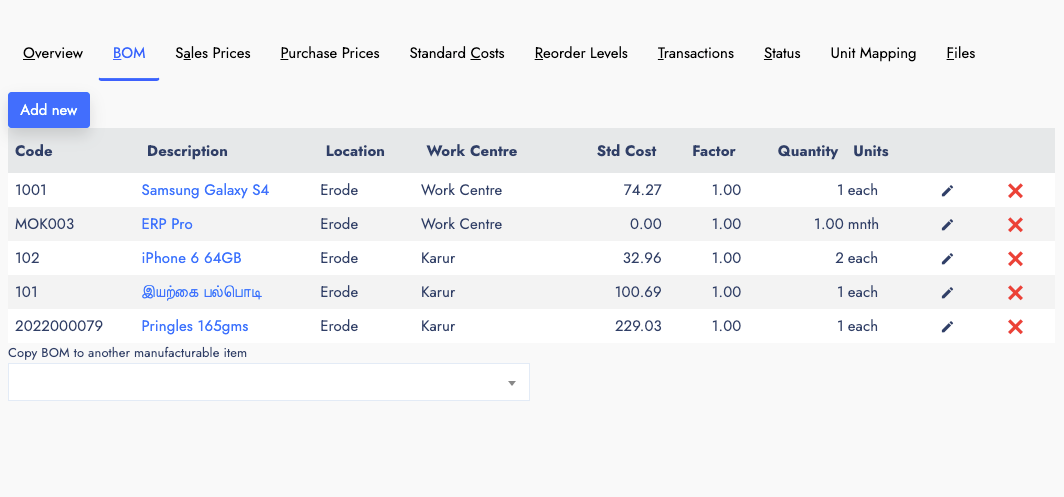
The bill of materials opens as a tab on the item and lists what goes into one unit. Its cost roll-up shows material with wastage, standard labour and standard overhead.
Every production job is a work order. It records the item, quantity, required-by date, work centre, team and the location the output goes to, and can be saved as a draft until it is ready.
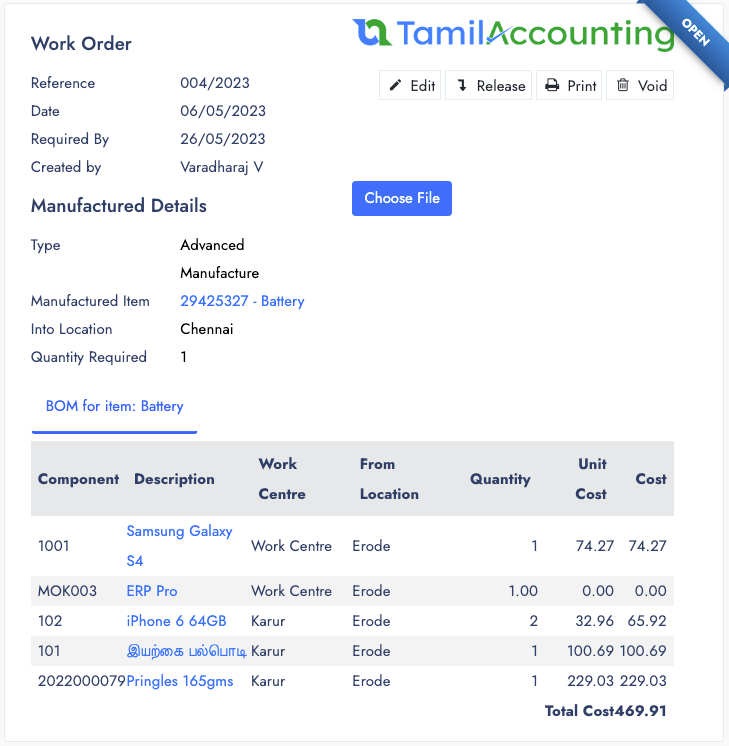
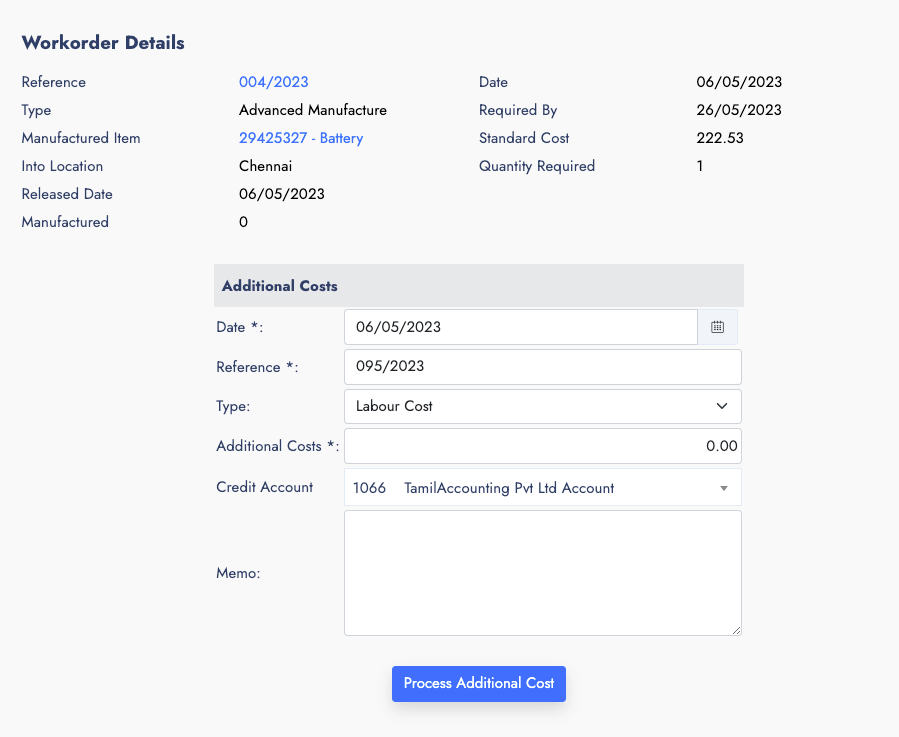
Releasing an order builds its material requirement from the BOM, wastage included. Anything the plan did not allow for is issued to that one order, and labour and overhead are charged to it as they are incurred.
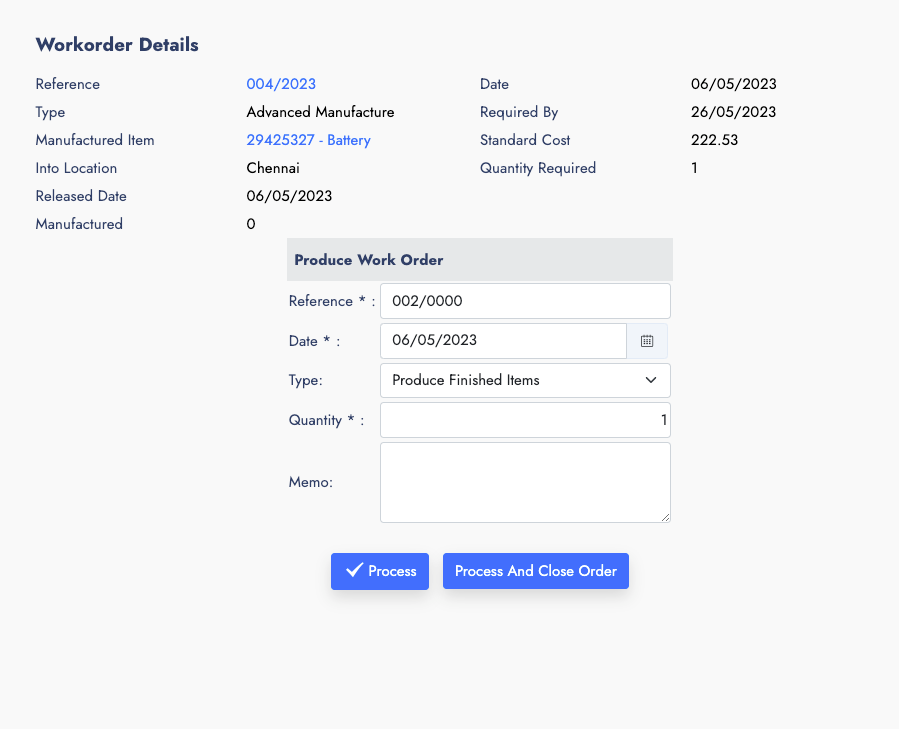
Produce the full quantity at once, or in several runs as the work finishes. Each run draws its components and puts the good output into stock straight away, at what that run drew.
The Overview shows open, in-progress, overdue and closed orders and units finished this month. The Board shows every open order once, in the furthest stage it has reached, with the action that moves it on: release, send materials, produce or receive, close.
Mark a supplier as a job worker and they get a stock location of their own. Set a work order to be made by them at an agreed rate per good unit; material goes out on a challan and comes back as a production receipt.
Sending material to a job worker is a stock move, not a sale: it goes to their location and, if you keep a separate Stock with Job Workers account, to that account. Nothing is earned or spent.
When the goods come back, the material and the agreed charge pass through the order’s work in progress into finished stock. When the bill arrives it clears the accrual, and a bill above or below the agreed rate shows up in cost of sales instead of disappearing.
Worked example — material sent ₹50,000, agreed charge ₹10 a good unit. The receipt and the bill post these; nobody types them.
| On the production receipt | Debit | Credit |
|---|---|---|
| Work in progress — material consumed | 50,000.00 | |
| Stock with job workers | 50,000.00 | |
| Work in progress — job-work charge | 10,000.00 | |
| Job-work charges accrued | 10,000.00 | |
| Finished goods stock | 60,000.00 | |
| Work in progress | 60,000.00 | |
| When the job worker bills ₹10,400 (before GST) | ||
| Job-work charges accrued | 10,000.00 | |
| Cost of sales — rate difference | 400.00 | |
| Supplier account — job worker | 10,400.00 | |
| Totals | 130,400.00 | 130,400.00 |
Illustrative figures. Each run puts its output into stock at what it drew, and closing the order settles anything work in progress still holds onto the finished item, so the order ends at zero.
Recorded on a demo company: one bill of materials run through all three work-order types, a job sent out to a job worker and brought back costed, and a textile order followed from yarn to e-invoice.
Bills of materials, the three work-order types, costing, the production board and the production reports.
Material goes to the job worker on a challan, stays your stock, and comes back with the charge added.
One order followed from the buyer to the signed QR — weaving, dyeing at a job worker, GST and the e-way bill.
Manufacturing has its own section in Reports. The summary reports filter by the work order’s work centre and team, and almost every report exports to Excel as well as PDF.
What to make, with what, and whether there is enough.
Where every order is, and what is out with job workers.
What it cost, what was lost and how the floor performed.
Raise a work order from a confirmed sales order, line by line, or tick Auto Work Order so saving the sales order creates them.
Plan Stages creates a work order for each sub-assembly you make, and the parent can’t close while a stage is open.
Centres with capacity, working days and hourly rates; teams with a leader, members and a labour rate; your own process types.
Rejections and machine stoppages are logged against reasons you define, and feed the yield and OEE reports.
Output carries its batch and expiry, components are drawn earliest-expiry first, and Batch Traceability follows a batch either way.
Where negative stock is not allowed, Quick Assemble won’t save while a component is short, nor Unassemble without stock.
One view shows requirements, issues, productions, costs, job work, sub-orders, job cards and the ledger entries behind them.
Save an order as a draft, send it for approval where your workflow asks for one, and approve or reject it from its view.
Switching software is the hard part. We help you move, keep your records sound, and keep improving the system with you.
Move across from Tally, Zoho, QuickBooks, Xero, Sage 50 or SMACC, or from Excel templates for items, customers, suppliers, employees, chart of accounts and opening balances. You preview every row before it is saved — and our team helps you through it.
Your database is backed up three times a day — every 8 hours — and your files are backed up too. Each company keeps its own separate database; roles decide who can see, enter, approve or void; every change is on the audit trail; and everything exports to Excel or PDF whenever you want it.
We follow up regularly with the businesses that use it, and their requests become features. Updates arrive on your account automatically — nothing to download or reinstall.
GST e-invoice and e-way bill, ZATCA, WooCommerce, WhatsApp, biometric devices, online payment gateways, mobile apps and an AI assistant — and new connections are added as the market moves.
Quick Assemble suits kits, combo packs and same-day assembly from parts already on the shelf — it finishes on save. Quick Unassemble breaks finished units back into their components. Produce in Stages is for production that takes time: release the order, produce in one run or several with batch, expiry and rejects recorded, add labour and overhead, then close.
Yes. A confirmed sales order with manufactured items can raise a work order for the order or for a single line, carrying the customer, item, quantity and delivery date across. You can also have work orders created automatically when the sales order is saved.
Each production run draws its components at their stock value and puts the output into stock at what it drew. Labour and overhead are added to the work order as they are incurred, and closing the order settles whatever cost it still holds onto the finished item. The Work Order Costing report shows material, labour, overhead and expenses for each order and the cost per unit against the BOM standard.
No. A bill of materials line can be set to all work centres, so one BOM serves every line and the work order says which work centre it runs on. Lines that only one centre uses can still name that centre.
No. A job worker is a supplier with a stock location of their own, so sending material on a challan moves it to that location — it is still your stock, at your cost. When it comes back, the good quantity, rejects, scrap and unused material are recorded, and the job worker’s charge accrues until their bill arrives.
Reopen it. Reopening reverses the close’s settlement, lets you void a run whose stock is still there or carry on producing, and you close it again when it is right. Orders closed before their cost was final can be cleared from the Settle WIP screen.
Yes. Output is recorded with its batch and expiry, rejected quantity is recorded with a reason on every run, and the Batch Traceability and Rejection and Yield reports follow them up. Serial numbers are not tracked in manufacturing.
Quality Control is a separate app you can switch on. It opens inspections on production and job-work receipts (as well as purchases, transfers and returns), can hold stock until a decision is made, and records non-conformance and certificates of analysis.
Start free with your own bills of materials and work orders — and switch on job work and quality control when you need them.
Supports GST (India), VAT (UAE, South Africa, Egypt, Iraq, Botswana), and local compliance across all regions.