Sales: quotation to cash, fully connected
Quotation to order, delivery to invoice, payment to allocation — every step linked.
Quotation, order, delivery, invoice, payment: each document picks up the one before it, posts its own ledger entry and lands on the customer’s account the moment it is saved. Then TamilAccounting helps you get paid — it chases overdue customers, suggests how each receipt should be matched and keeps every discount visible.
Shipped this year: shorter chases for payment, cleaner matching, safer corrections and invoices that look like your business.
One follow-up case per overdue customer: log every call, record a promise with its date and amount, and a broken promise comes back to you the next morning. Automatic email and WhatsApp reminders stay off until you switch them on — and are held when an unallocated receipt already covers the overdue.
Watch the walkthroughOpen an unpaid invoice or an unused receipt and its Allocations tab proposes the match, oldest due date first. Change any amount, then allocate in one click — over-allocation is refused.
Learn moreA new designer opens on your real invoice PDF: drag the logo, resize columns, add a thank-you note or bank details, and nothing changes what you print until you press Make default.
Watch the walkthroughDelete an invoice, credit note or delivery as Restorable and bring it back later, fully posted. A cash sale returns with its payment re-applied and the invoice marked Paid.
Watch the walkthroughType a minus to discount the bill or a plus to round it up, on deliveries and invoices. Line, bill and round-off discounts each post to their own account, so sales stay gross.
Watch the walkthroughWhen an order is delivered and invoiced in parts, each part takes its share of what is left of the order’s discount and freight — the last part never carries it all again.
Watch the walkthroughReceiving from a foreign-currency customer now shows the exchange rate on the payment itself, plus a bank rate when the bank account is in a third currency.
Learn moreFor Indian companies, the IRN, signed QR and e-way bill are raised from the sales invoice, and the invoice locks against edit and void while they are active.
Learn moreEach online payment captured against a shared invoice can be recorded as a customer payment, pre-filled with the exact amount, date and bank charge.
Learn moreMost of it is not lost to bad customers. It is lost to retyping, forgotten follow-ups and receipts nobody matched.
The quote is in a spreadsheet, the order in an email, the invoice in the accounts package. Each retype is a chance to change a price, a quantity or a tax rate.
Cost: invoices that do not match what was agreed or what was shipped.
An invoice slips past its due date, the promise made on the phone sits on a sticky note, and by the time anyone looks, the balance is ninety days old.
Cost: cash locked in receivables while you borrow to run the business.
One transfer pays three invoices, an advance sits on account, a credit note is never applied. Until each is matched, statements show balances that are not true.
Cost: customers chased for money they already paid.
When a discount simply reduces the sale, nobody can say at year end how much discounting cost the business — or which salesperson gave it away.
Cost: margin you cannot measure, so you cannot manage.
An order delivered in three lots gets its discount or freight charged on every lot — or on none — and somebody fixes it with a credit note later.
Cost: disputes with customers and totals that do not tie back to the order.
Remove a “duplicate” invoice that was not a duplicate and the lines, the stock movement and the payment link all have to be rebuilt by hand.
Cost: rework, and books that are wrong while it happens.
Each step carries forward what came before it — lines, prices, discounts, references — and posts its own accounting entry as it happens.
The same screens your sales team already understands — with the accounting done for them.
A quotation picks up the customer’s sales type, payment terms and prices on its own. When the customer agrees, it becomes a sales order without retyping a line.
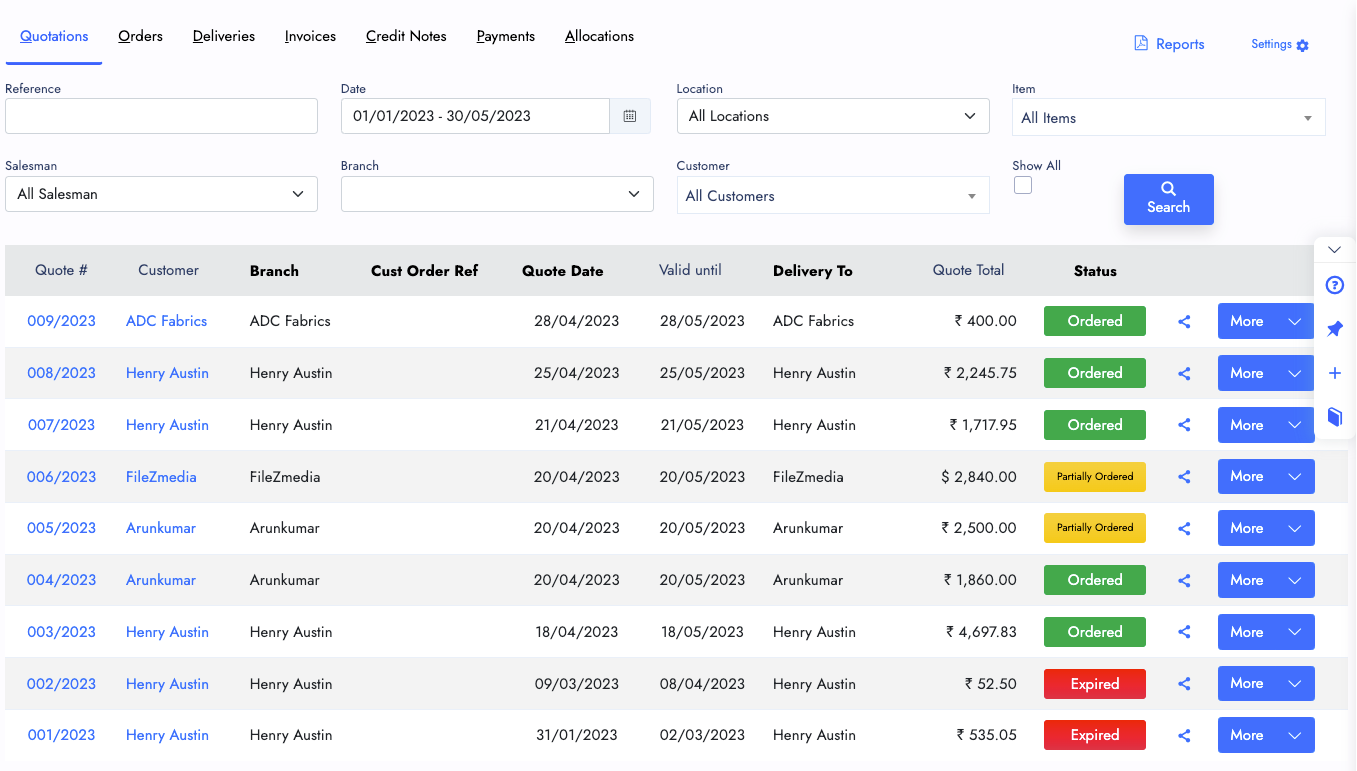
Deliver from the order or make a direct delivery. Stock comes off the shelf the moment it is saved, and the delivery becomes the invoice for exactly what went out.
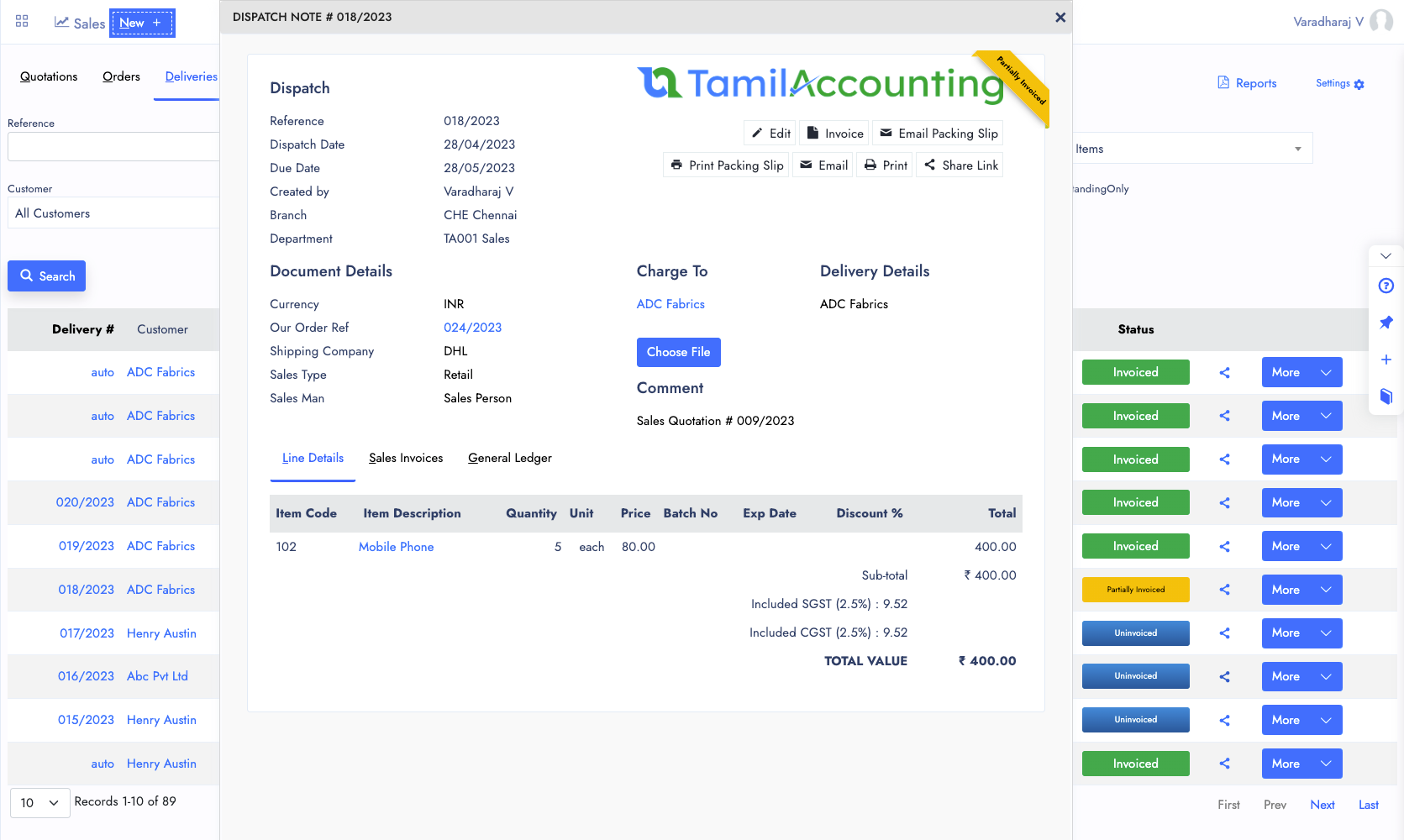
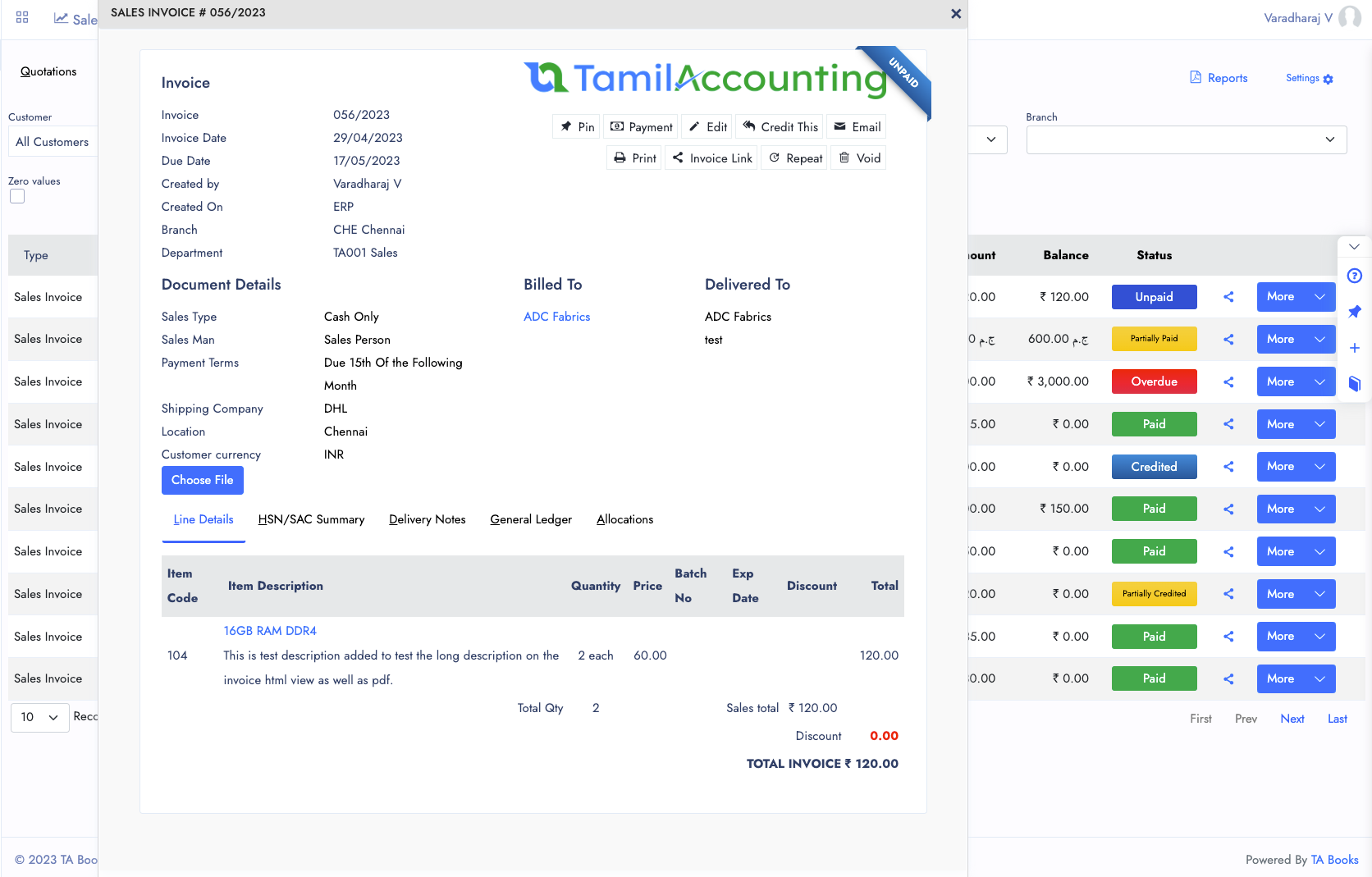
Invoice from a delivery or directly. Payment terms set the due date, the reference follows the number format you chose, and the ledger entry is posted for you.
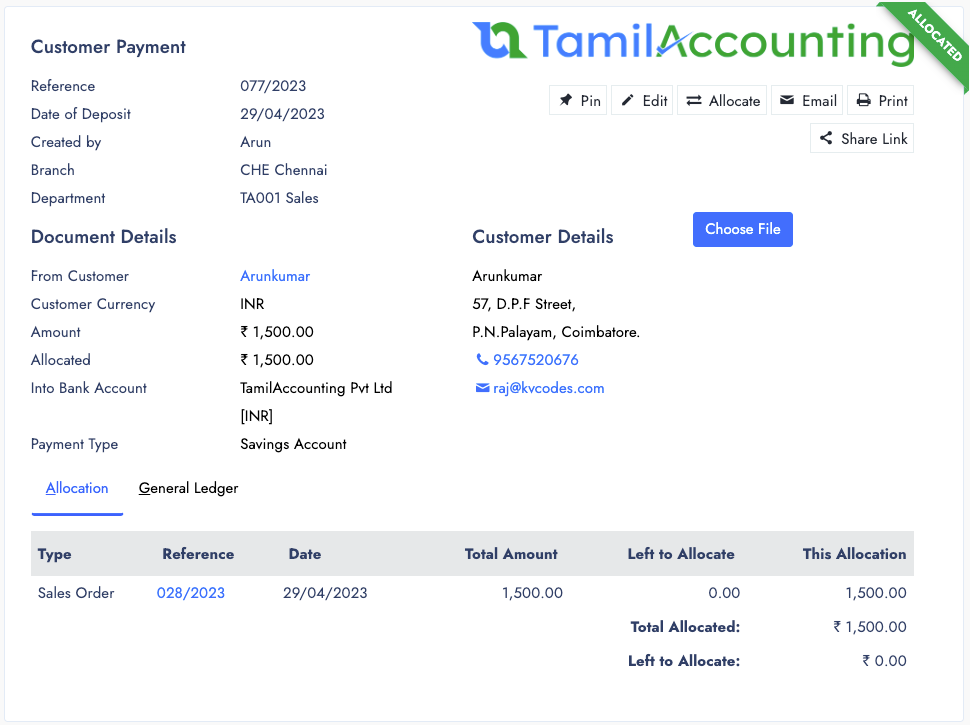
One payment can settle many invoices, and one invoice can be paid in several parts. The Allocations tab on the receipt or the invoice suggests the match for you.
Sales › Reminders opens one case per overdue customer, with the overdue amount, the oldest due date and who owns the follow-up. The figures come fresh from the invoices every time, so a case closes itself when the customer pays.
Raise a credit note against an invoice, or a direct one. Returned stock goes back on the shelf, and the credit is refunded or applied to other invoices.
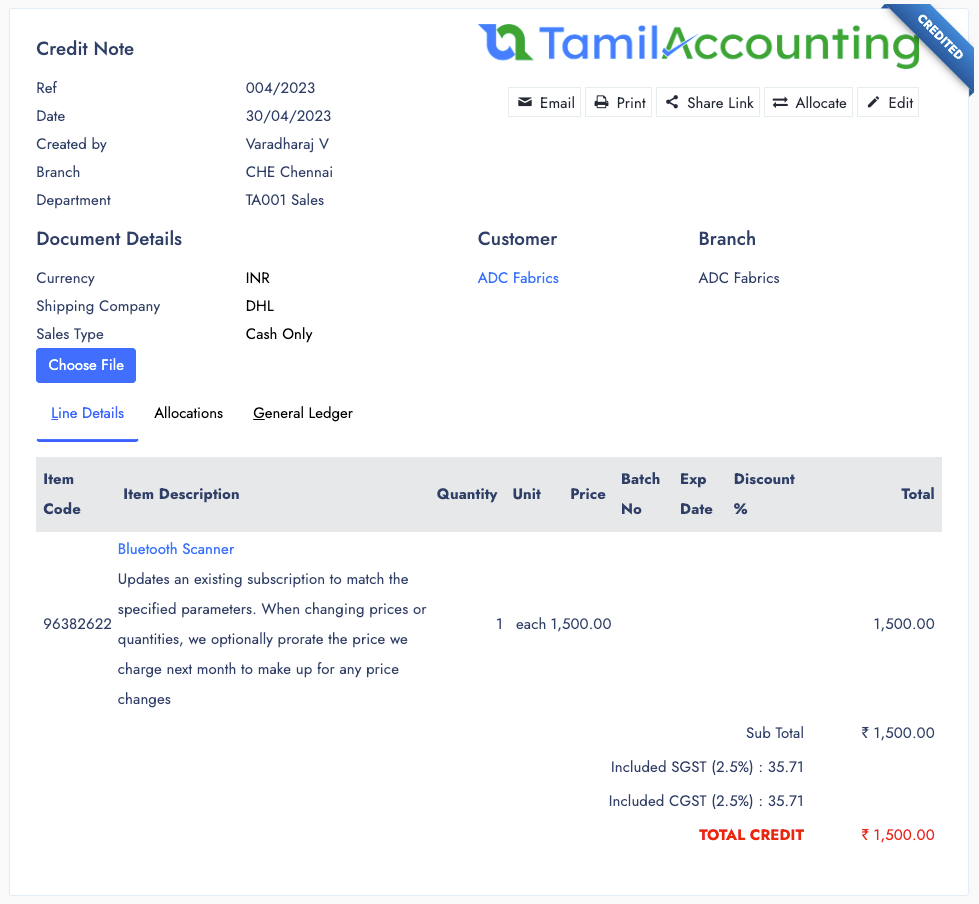
A discount is never buried inside the sale. Sales are credited gross and every discount is posted to its own account, so you can see at year end exactly what discounting cost.
Item A 10 × 100 with 10% off the line · Item B 5 × 100 · 100 off the bill · tax 18% on 1,400 (illustrative)
| Posted by the invoice | Debit | Credit |
|---|---|---|
| Customer account | 1,552.00 | |
| Discounts given — line | 100.00 | |
| Discounts given — bill | 100.00 | |
| Sales, at full price | 1,500.00 | |
| Output tax | 252.00 | |
| Totals | 1,752.00 | 1,752.00 |
A line discount always lowers the taxable value. A bill discount or round-off lowers it only when the company setting for it is switched on — here it is off, so tax is worked out on 1,400. The accounts used follow your own setup.
Order value 3,000 · each part takes its share of what is left
| Part delivered | Value | Discount |
|---|---|---|
| First delivery | 1,000.00 | 100.00 |
| Second delivery | 1,200.00 | 120.00 |
| Last delivery | 800.00 | 80.00 |
| Whole order | 3,000.00 | 300.00 |
The parts add back to the order exactly. Freight on the order is shared the same way.
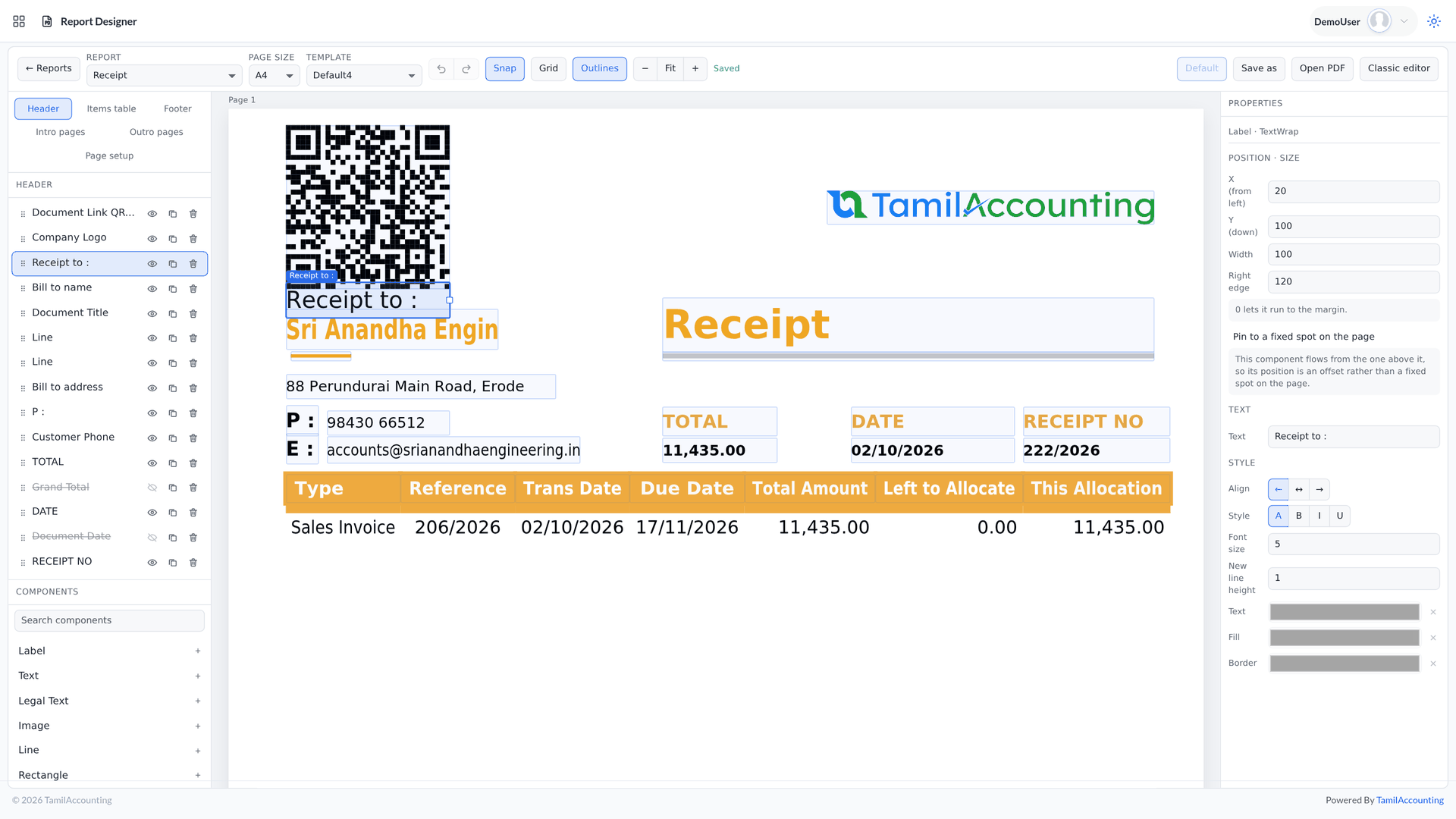
The Report Designer opens your latest invoice exactly as it prints. Click any part — the logo, the heading, the totals, the item table — and move it, resize it or restyle it, and the page re-renders from the same engine that prints it.
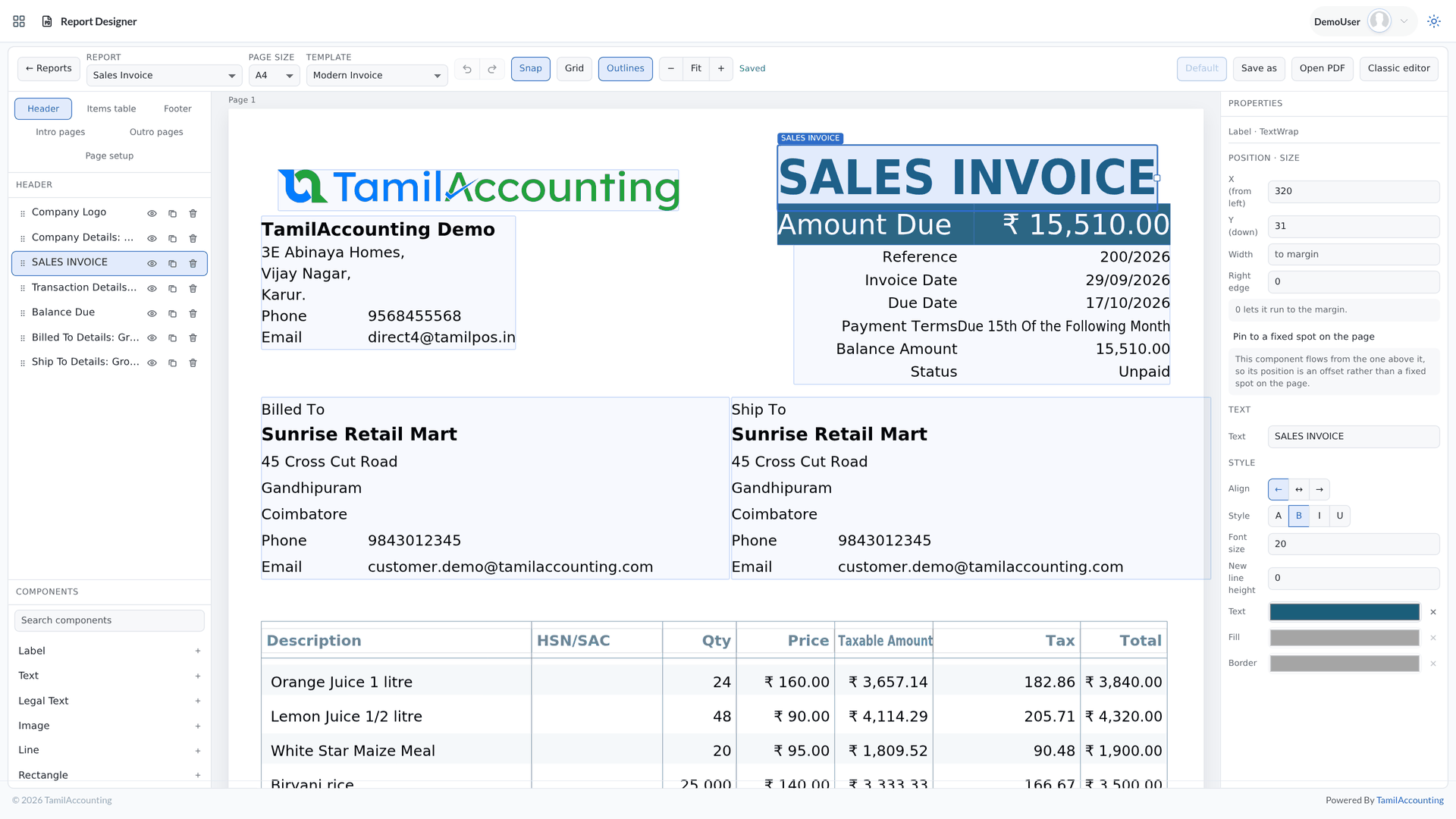
Every sales document opens in the same designer as its real PDF — move, resize and restyle it the same way.
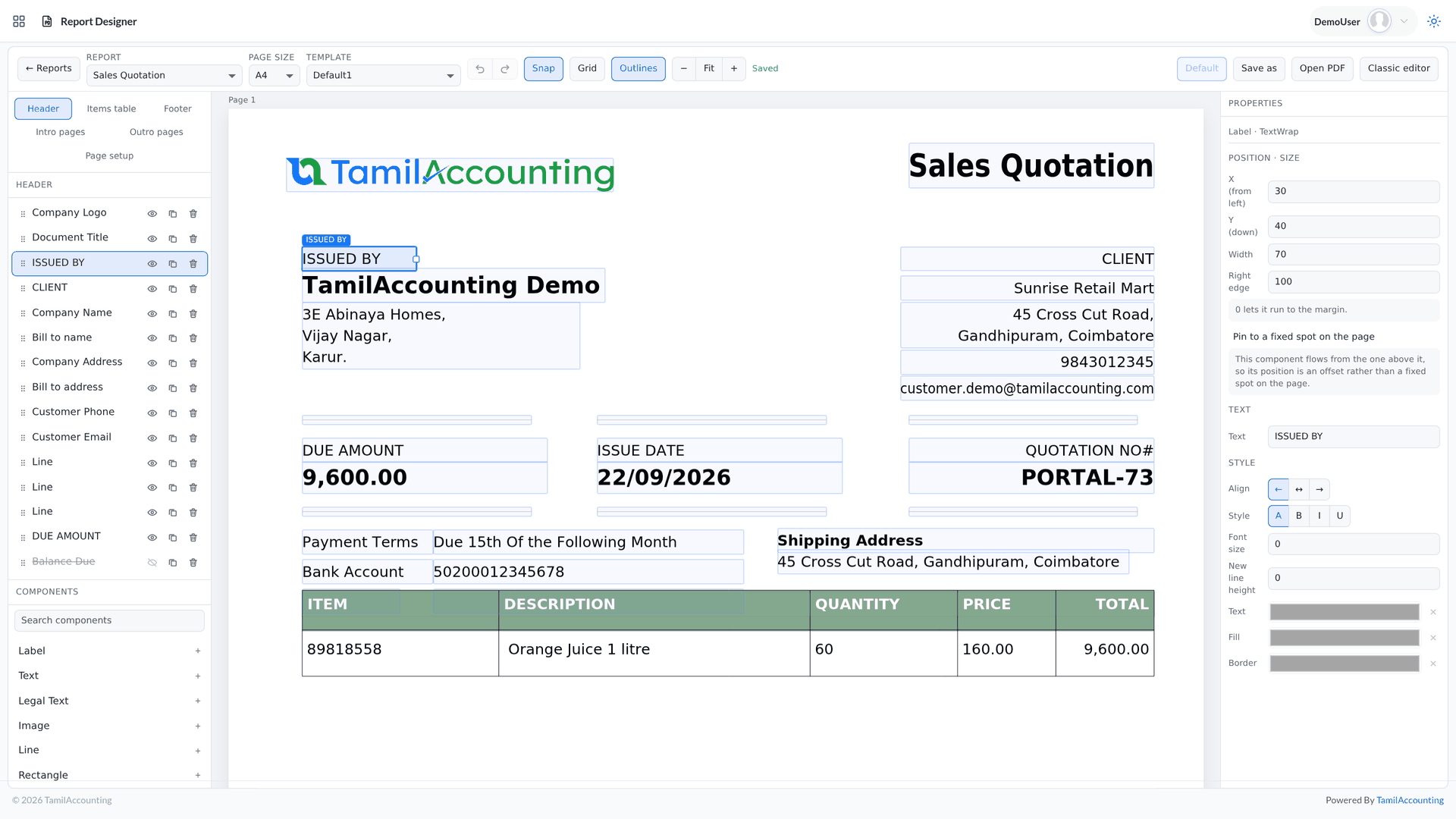
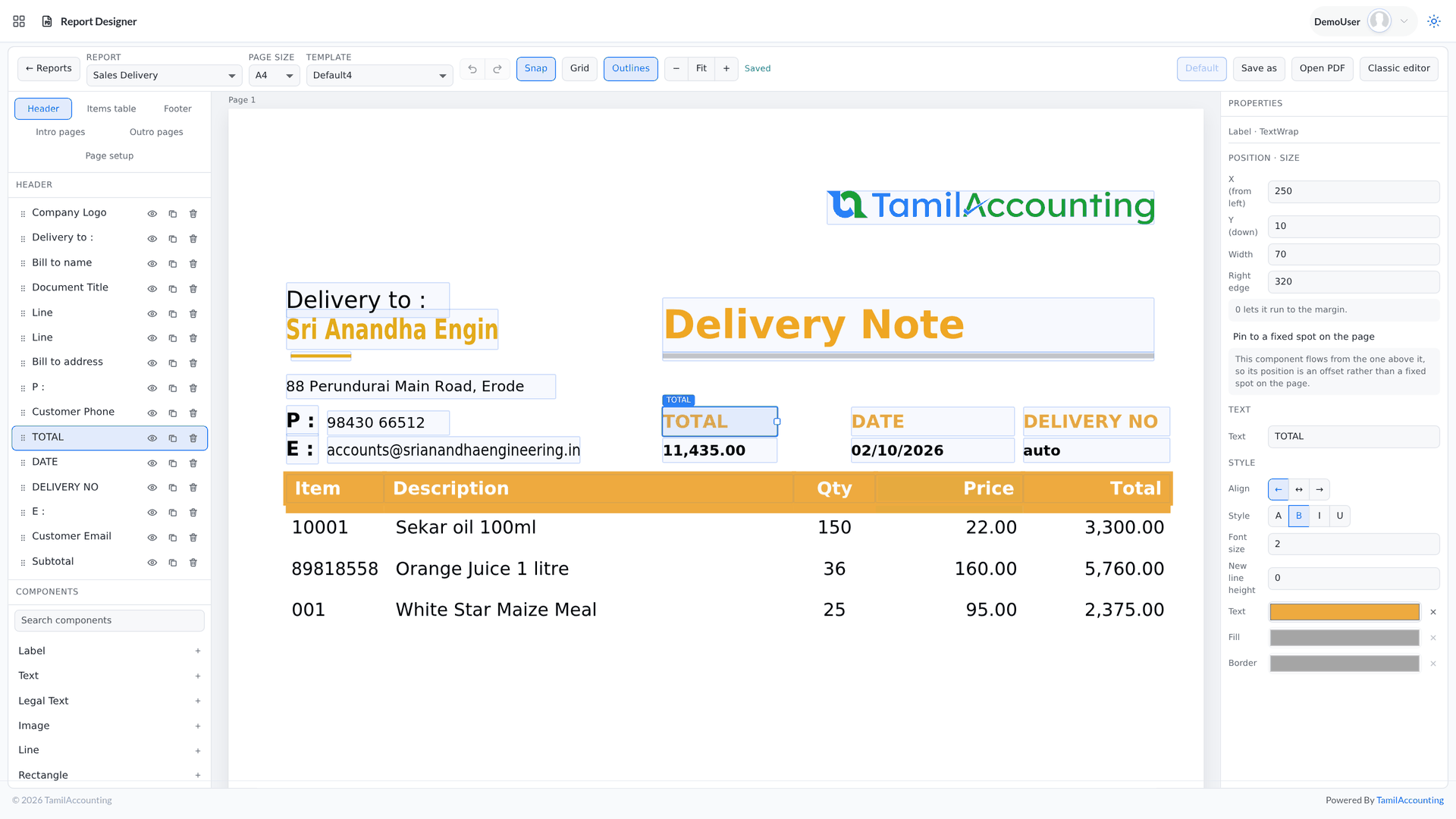
Recorded on a demo company: the full sales flow, the collections desk for overdue customers, every kind of discount with its ledger entries, restoring a deleted invoice and designing an invoice by dragging it.
Quotation to order, delivery to invoice, payment to allocation — every step linked.
Follow-ups, promises to pay and escalation for every overdue customer.
Line, percentage and amount discounts, a grand discount and round-off — and the ledger entries behind each.
Move the logo, restyle the title and add a note right on the real PDF — the new invoice designer.
Voided and deleted transactions can be brought back, with the trail intact.
Revenue and receipts this month, receivables, overdue, open orders, six months of revenue, top customers and recent invoices on one screen.
The same drag-and-drop designer shapes quotations, orders, delivery notes, receipts, credit notes and balance letters as well as invoices.
Set an invoice to repeat every few days, weekly, monthly or yearly, and the person who set it up is told when each one is created.
Send any document as a secure link the customer opens without a login. Where an online payment gateway is set up, they can pay from the invoice.
Credit status per customer can stop new invoices for an account on hold, alongside credit limits, areas and customer groups.
Each salesperson linked to a user, with provision rates and a turnover break point, and sales reports by salesperson.
Customer ageing, balances and balance confirmation letters, sales summaries by item, profitability and order summaries, in PDF or Excel.
Bring sales invoices in from a spreadsheet template when you move across from another system, instead of keying them one by one.
Switching software is the hard part. We help you move, keep your records sound, and keep improving the system with you.
Move across from Tally, Zoho, QuickBooks, Xero, Sage 50 or SMACC, or from Excel templates for items, customers, suppliers, employees, chart of accounts and opening balances. You preview every row before it is saved — and our team helps you through it.
Your database is backed up three times a day — every 8 hours — and your files are backed up too. Each company keeps its own separate database; roles decide who can see, enter, approve or void; every change is on the audit trail; and everything exports to Excel or PDF whenever you want it.
We follow up regularly with the businesses that use it, and their requests become features. Updates arrive on your account automatically — nothing to download or reinstall.
GST e-invoice and e-way bill, ZATCA, WooCommerce, WhatsApp, biometric devices, online payment gateways, mobile apps and an AI assistant — and new connections are added as the market moves.
Only if you ask it to. Automatic email and WhatsApp reminders are off until you switch them on in the Payment Reminders settings. Until then the system opens a case for each overdue customer and reminds your own team, without contacting anyone outside. Even when switched on, a reminder is held if the customer has unallocated receipts or credits that already cover the overdue amount.
Yes. A receipt can be allocated across as many invoices as it covers, in full or in part, and one invoice can be settled by several payments. The Allocations tab suggests the split for you, oldest due date first, and anything left over stays on account for the next invoice.
A line discount always does, because the line is discounted before tax is worked out. A discount or round-off on the whole bill reduces the taxable value only when the company setting Grand Discount & round-off affect tax is switched on.
Yes, if you chose Restorable when you voided it. Open the Voided / Deleted register under Setup and press Restore: the invoice is posted again with its original number when that number is still free, or a new one if it has been used. Payments you had allocated by hand are flagged for you to re-apply. A permanent void cannot be undone.
Yes. Each sales type is its own price list, with or without tax included, and a customer’s default price list comes with them onto every quotation, order and invoice. A list can also be calculated from another with a factor, so you do not have to price every item twice.
Yes. Share an invoice by email, WhatsApp or a secure link, or give the customer a portal login to see their invoices, deliveries and statement. Where an online payment gateway is set up, they can pay from there, and the payment comes back to be recorded against the invoice.
Yes. The Designer opens your latest invoice as the real PDF: drag and resize fields, change fonts and colours, add your bank details or a note. Work on a copy with Save as; your printed invoices change only when you press Make default, and the standard layout is always there to go back to.
Yes. A customer can be billed in their own currency. The customer payment shows the exchange rate for the payment date, and the exchange difference between invoice and receipt is posted to the ledger for you.
Start with your own customers and items — quotation to cash, reminders and allocations included.
Supports GST (India), VAT (UAE, South Africa, Egypt, Iraq, Botswana), and local compliance across all regions.