Purchases: order to payment, fully matched
Purchase order to GRN to a matched supplier bill to payment, without retyping.
Requisition, quotation, purchase order, goods receipt, supplier bill, payment: each document picks up the one before it, so a supplier can never bill more than you received. TamilAccounting posts every step to the ledger, keeps each supplier’s account current and reminds your own team before a bill goes overdue.
Shipped this year: suppliers who do their side of the work, receipts that record what really arrived, and payables nobody forgets.
A dashboard panel lists every supplier you owe, biggest overdue first, with each one’s aged position and a Pay supplier button. Reminder cases nudge your own team until the bill is paid — suppliers are never contacted.
Watch the walkthroughWhen a supplier ships more than you ordered, record the extra as priced or as free. Free units go into stock at no value, so the average cost drops and the supplier bill charges only what you pay for.
Watch the walkthroughSuppliers sign in to answer your quote requests, accept purchase orders, file dispatch notes and submit bills against what you received — and see what you have paid them.
Learn moreInvite several suppliers to price the same lines, compare their quotes side by side and turn the best one into a purchase order. Suppliers without a portal login can quote from a share link.
Learn moreWhen an order arrives in several goods receipts, each one takes its share of what is left of the order’s discount and freight, so the receipts add back to the order exactly.
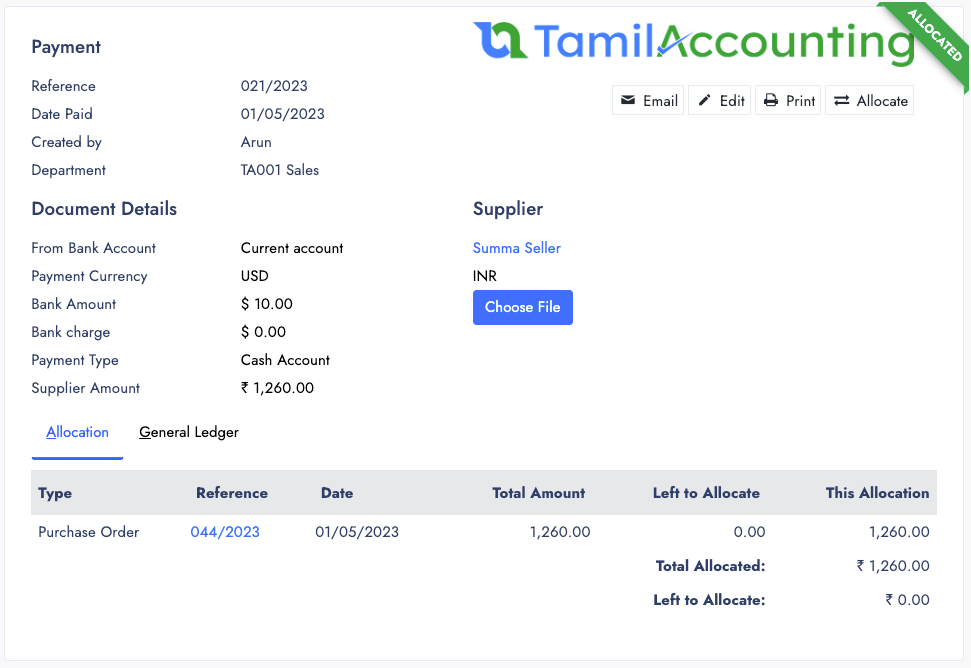
Paying a foreign-currency supplier shows the exchange rate on the payment itself, plus a bank rate when the bank account is in a third currency.
Learn moreA supplier payment or debit note proposes the open bills it can settle, oldest due date first; a bill proposes the unallocated payments and debit notes of the same supplier.
For Indian companies, record the supplier’s IRN against their bill and validate it, then reconcile the period’s GSTR-2B against your purchase register to see which credits are at risk.
Learn moreAn optional app for supplier rebates earned on purchases and settled later: the rebate is accrued from your supplier terms and settled against the supplier’s account when it is agreed.
Learn morePurchasing is where cash actually leaves the business. Most of what leaks is not fraud — it is bills nobody checked, extras nobody recorded and due dates nobody watched.
The supplier bills the full order, the store received part of it, and nobody puts the two side by side before the payment goes out.
Cost: paying for stock you do not have, then chasing a refund.
A supplier adds ten free units to a hundred. Either they never reach the stock register, or they are booked at full price and the item cost is wrong from then on.
Cost: stock counts that never agree, and margins worked out on the wrong cost.
Eight bills from one supplier, the oldest two months late, and nobody noticed until the supplier put you on credit hold.
Cost: lost credit terms, missed early-payment discounts, strained suppliers.
An advance paid against an order, a debit note for damaged goods, a payment that covered three bills — until each is matched, the supplier’s balance is a guess.
Cost: double payments and statements that never reconcile.
Did you get our quote? Was the order approved? When will the lorry arrive? Where do we send the invoice? Every answer is in the books, but only your staff can read it.
Cost: hours a week spent relaying information instead of buying well.
A bill is in your books, but the supplier never filed it. Nobody finds out until the return is due and the credit you counted on is not there.
Cost: input tax credit lost or reversed, with interest.
Each step is raised from the one before it, so nothing is typed twice — and each step writes its own accounting entry as it happens.
Each stage lives on its own tab in Purchases, and every document opens its connected documents — order to receipt to bill to payment — in one click.
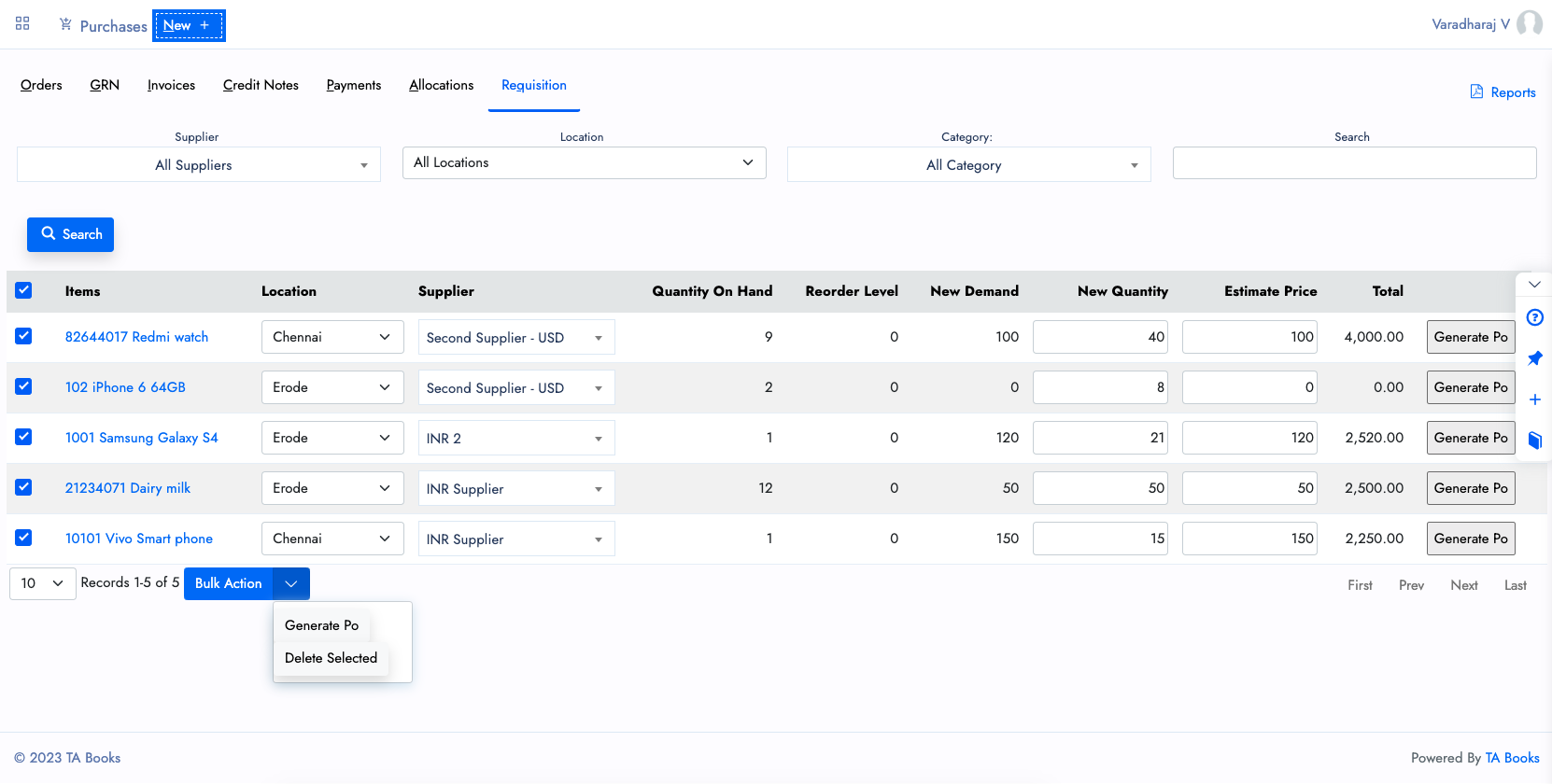
Set a reorder level for each item at each location. When stock falls below it, the item joins the requisition list with a suggested quantity and price, ready to become a purchase order, a direct invoice or a request for quotation.
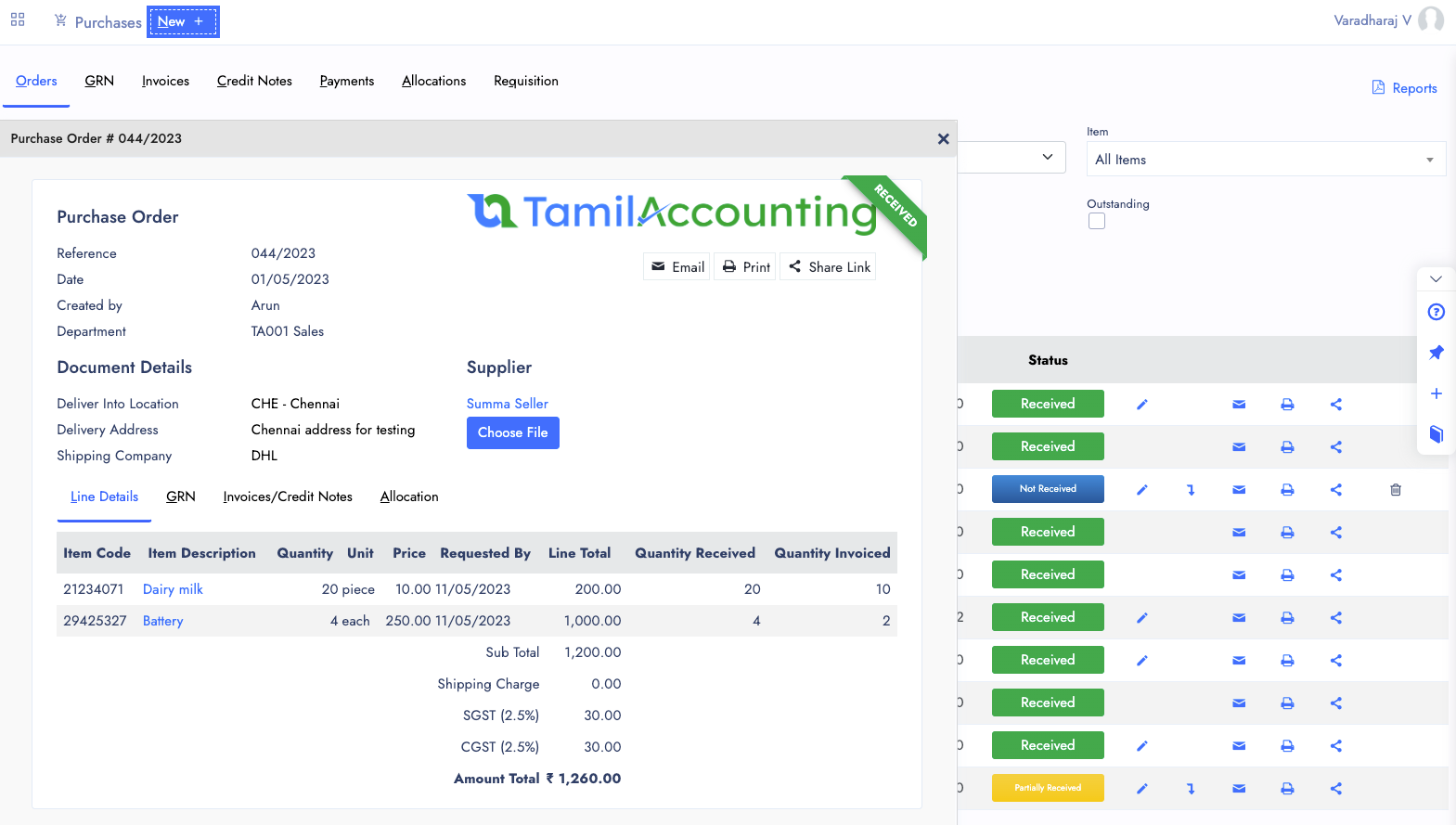
The order carries the supplier, delivery location and date, each line with its quantity, unit and price, and the payment terms. Share it as a link or let the supplier open it in their portal, where accepting it shows on your order as Supplier Accepted.
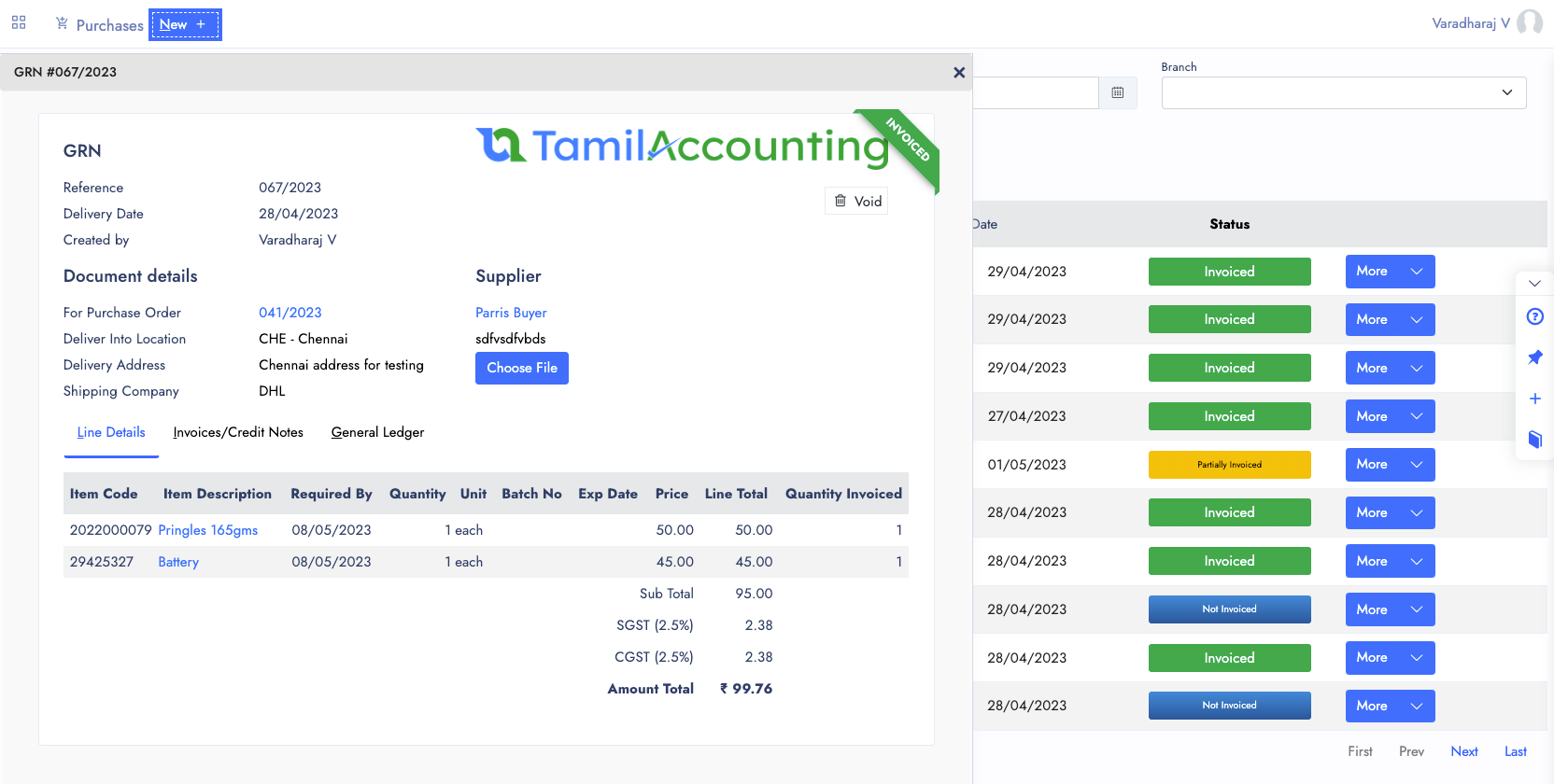
The goods receipt is raised from the order line by line. It shows what was ordered, already received, still outstanding and what the supplier declared on their dispatch note, so the receiver checks the lorry against both.
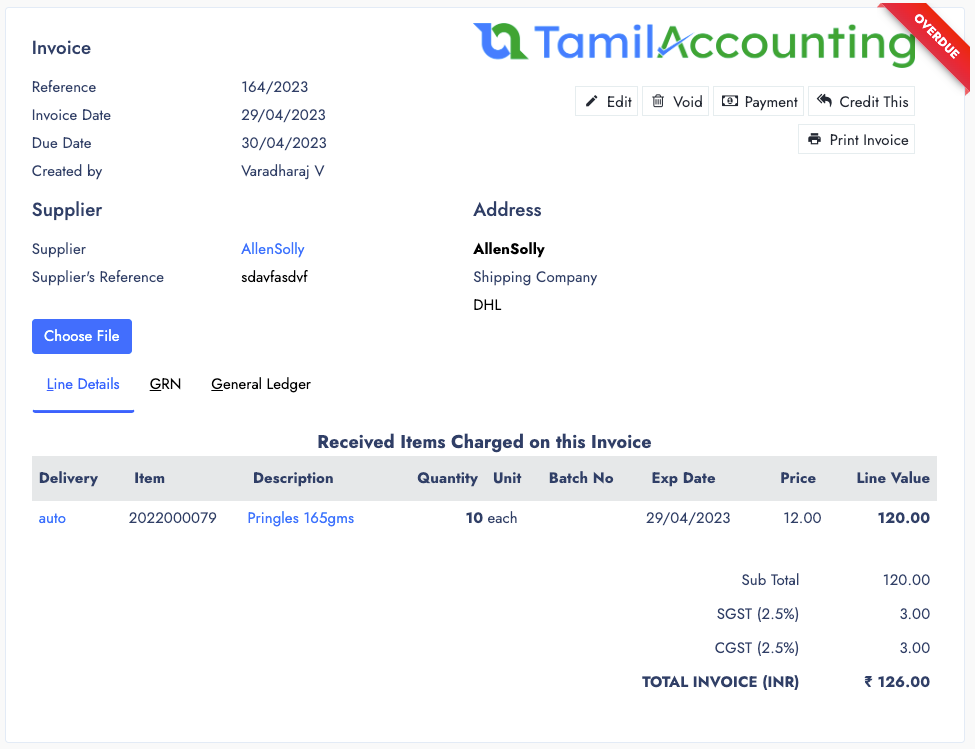
Turn one or more goods receipts into the supplier’s bill. An inflated quantity or a short delivery shows up the moment the bill is entered, not weeks later on the supplier’s statement.
One payment can cover several bills, or several payments can settle one bill. The Allocations tab proposes the match — oldest due date first — and you change any amount before you confirm.
The Supplier Payables panel lists every supplier with a balance, biggest overdue first. Open one to see their open bills, payments not yet matched, net payable, and what is overdue by age band — then pay them from the same window.
You order 100 units at 10.00. The supplier ships 110 and says the extra 10 are free. On the goods receipt you enter 100 under This Delivery and 10 under Free.
All 110 go into stock, but only the 1,000.00 you pay for is valued. The average cost of the item falls to 9.09 on its own, and the supplier’s bill charges exactly 1,000.00 — so the goods-received account clears to zero.
Had the supplier charged for all 110, you would enter 110 under This Delivery instead: stock and the bill both rise to 1,100.00 and the cost stays at 10.00.
Nobody types these entries — the goods receipt and the supplier bill post them
| On the goods receipt (110 units into stock) | Debit | Credit |
|---|---|---|
| Inventory | 1,000.00 | |
| Goods received, not yet billed | 1,000.00 | |
| On the supplier bill (100 units at 10.00, before tax) | ||
| Goods received, not yet billed | 1,000.00 | |
| Supplier account | 1,000.00 | |
| Totals | 2,000.00 | 2,000.00 |
Stock: 110 units valued at 1,000.00, an average of 9.09 each. Illustrative figures.
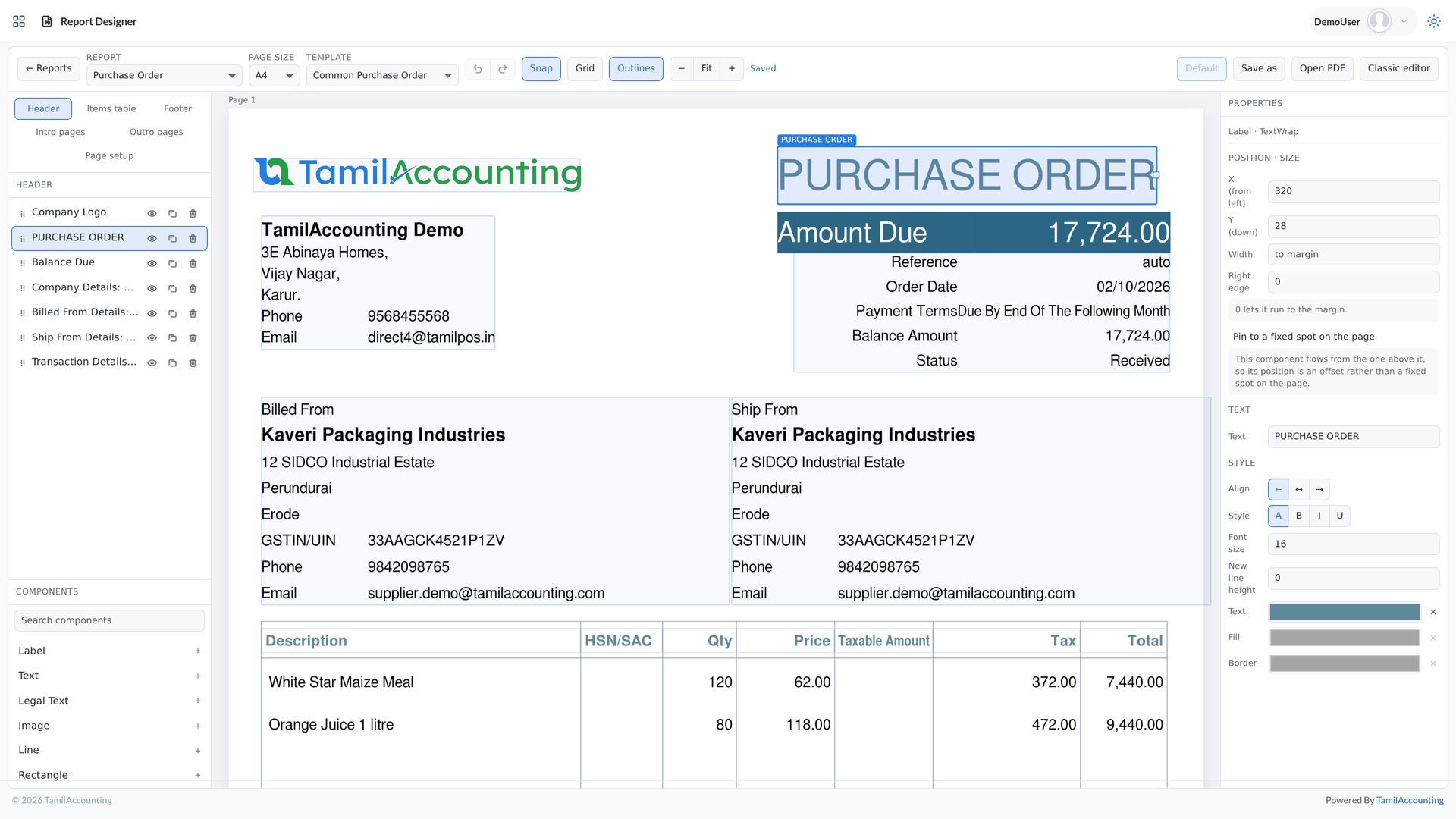
Open the purchase order, the goods received note, the supplier invoice or the remittance advice in the Report Designer and it shows the real PDF your supplier receives. Click any part to move, resize or restyle it.
Recorded on a demo company: order, goods receipt, a matched supplier bill and the payment — plus the payables panel and what to do when the supplier sends more than you ordered.
Purchase order to GRN to a matched supplier bill to payment, without retyping.
The payables panel, the aged position and reminders so no supplier bill is paid late.
When the supplier sends more than ordered — receive the extra as priced or as free stock.
Suppliers answer quotes, confirm POs, dispatch and send bills themselves.
Define the expenses you record every month — rent, power, telephone — once, and post them in a few clicks.
Save a bill or payment as a draft and finish it later; nothing reaches the ledger until it is processed.
A percentage discount on each line plus a discount or round-off on the whole document, each posted to its own account.
Order, receive, bill and pay in the supplier’s currency, with the exchange rate on each document.
Send a purchase order, quote request or debit note to the supplier as a secure link, without giving them a login.
Attach the supplier’s bill, delivery challan or quote to the document it belongs to, from any view.
A posted bill, receipt or debit note is voided rather than erased, and its ledger entries are reversed with it.
Supplier balances, aged payables, supplier trial balance, outstanding goods receipts, order and return summaries.
Switch on the ones you need; for everyone else, the standard flow stays exactly as it is.
Switching software is the hard part. We help you move, keep your records sound, and keep improving the system with you.
Move across from Tally, Zoho, QuickBooks, Xero, Sage 50 or SMACC, or from Excel templates for items, customers, suppliers, employees, chart of accounts and opening balances. You preview every row before it is saved — and our team helps you through it.
Your database is backed up three times a day — every 8 hours — and your files are backed up too. Each company keeps its own separate database; roles decide who can see, enter, approve or void; every change is on the audit trail; and everything exports to Excel or PDF whenever you want it.
We follow up regularly with the businesses that use it, and their requests become features. Updates arrive on your account automatically — nothing to download or reinstall.
GST e-invoice and e-way bill, ZATCA, WooCommerce, WhatsApp, biometric devices, online payment gateways, mobile apps and an AI assistant — and new connections are added as the market moves.
No. Supplier reminder cases never contact the supplier. They remind the people on your side who approve and release payments, and escalate to the person you name when a bill stays unpaid.
No. A supplier invoice raised from a goods receipt cannot claim more than was received, and a goods receipt cannot exceed the purchase order unless you have set an over-receive allowance. A short delivery or an inflated bill shows up the moment it is entered.
Set a Delivery Over-Receive Allowance in GL Setup, then enter the paid quantity under This Delivery and the extra under Free on the goods receipt. All the units go into stock, you pay only for the priced ones, and the average cost of the item comes down.
Yes. A purchase order can state the pre-payment it requires, and a payment made from the order is allocated to it, so the order shows what has already been paid in advance. Otherwise pay from the invoice itself, or later against several invoices at once.
Yes. Set reorder levels for each item at each location; when stock falls below them, the items appear on the requisition list, ready to become a purchase order, a direct invoice or a request for quotation.
No. Each invited supplier can get their own share link to view the request and quote prices, validity and lead time, or decline. Suppliers with a portal login answer the same request from their portal.
Raise a debit note from the supplier invoice. The returned items leave stock, the amount you owe goes down, and the note can be allocated against that invoice or another open bill.
Yes, for Indian companies. Upload the period’s GSTR-2B file and each document is shown as matched, filed by the supplier but missing from your books, or in your books but not yet filed — with your value and the filed value side by side.
Start free with your own suppliers and items — and add the supplier portal, approvals or landed cost when you need them.
Supports GST (India), VAT (UAE, South Africa, Egypt, Iraq, Botswana), and local compliance across all regions.