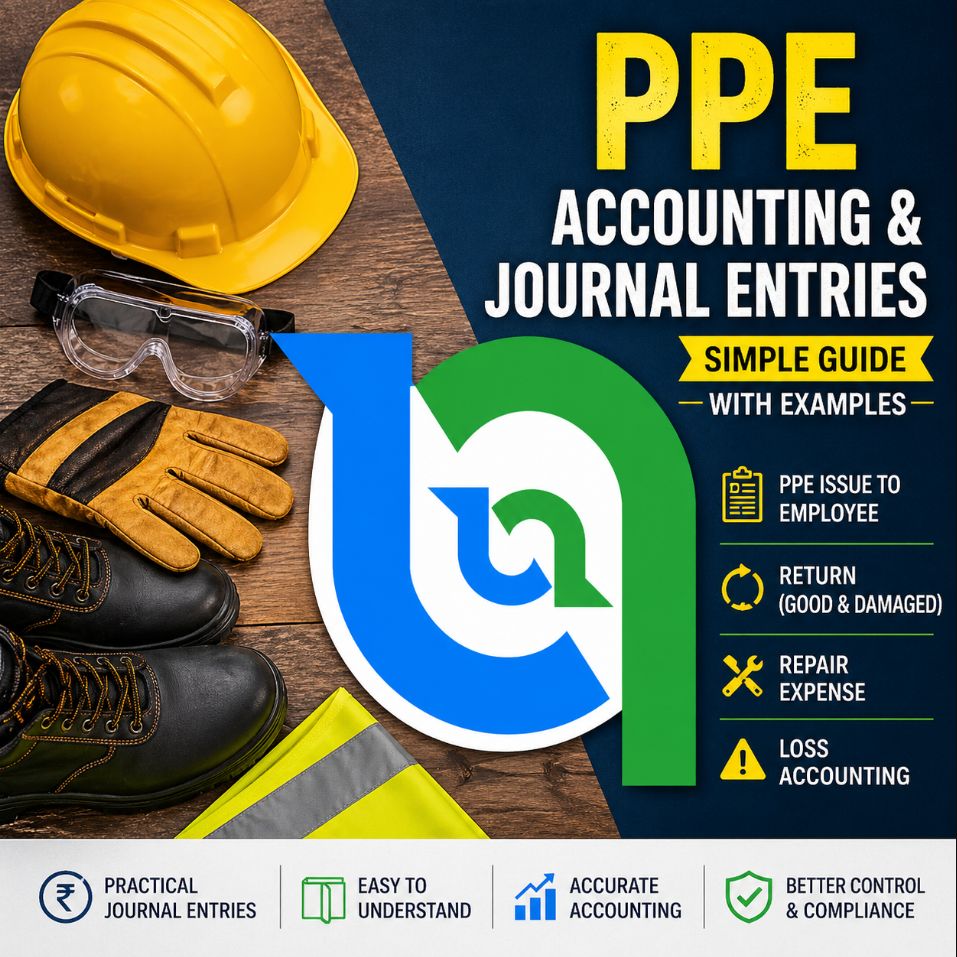
PPE Supplies Accounting and Journal Entries – Practical Guide with Examples
Personal Protective Equipment (PPE) such as helmets, safety shoes, gloves, and uniforms are essential for ensuring employee safety. From an accounting perspective, PPE handling involves proper tracking of inventory, assignment to employees, returns, repairs, and losses.
This article provides a complete and practical guide to PPE accounting with realistic examples.
1. PPE Procurement and Inventory
When PPE items are purchased, they are recorded as inventory:. this generally not required, our ERP itself it handles this inside the Supplier invoice.
Journal Entry:
Inventory A/c Dr
To Supplier / Cash A/c
This ensures PPE is available for issue and properly tracked.
2. PPE Assignment to Employees
When PPE is issued to employees, it is transferred from inventory to an “Asset Assigned” account for tracking responsibility.
Example:
4 PPE items issued
Cost per item = ₹500
Total value = ₹2,000
Journal Entry:
Asset Assigned A/c Dr 2,000
To Inventory A/c 2,000
3. PPE Return – Good Condition
If PPE is returned in good condition, it is moved back to inventory.
Example:
1 item returned (₹500)
Journal Entry:
Inventory A/c Dr 500
To Asset Assigned A/c 500
4. PPE Return – Damaged and Repaired
If PPE is returned damaged but repairable, two separate transactions should be recorded.
Example:
1 item returned (₹500)
Repair cost = ₹100
(a) Return of PPE to Inventory
Inventory A/c Dr 500
To Asset Assigned A/c 500
(b) Repair Expense
Repair & Maintenance A/c Dr 100
To Payable / Vendor A/c 100
This ensures clear separation between asset movement and expense.
5. PPE Loss
If PPE is lost and cannot be recovered, it is written off as an expense.
Example:
2 items lost
Total value = ₹1,000
Journal Entry:
Asset Loss Expense A/c Dr 1,000
To Asset Assigned A/c 1,000
6. Summary of Transactions
| Scenario | Debit | Credit | Amount |
|---|---|---|---|
| Issue to employee | Asset Assigned | Inventory | 2,000 |
| Return (good) | Inventory | Asset Assigned | 500 |
| Return (damaged) | Inventory | Asset Assigned | 500 |
| Repair expense | Repair Expense | Payable | 100 |
| Loss | Loss Expense | Asset Assigned | 1,000 |
7. Key Accounting Principles
PPE inventory is treated as a current asset
PPE issued is tracked under Asset Assigned for accountability
Repairs are treated as expenses
Lost PPE is written off to loss account
Always separate asset transactions and expense entries
8. ERP Implementation Best Practices
To manage PPE effectively in an ERP system:
Maintain PPE inventory master
Track employee-wise issuance
Capture return condition (Good / Damaged / Lost)
Record repair costs separately
Enable approval for loss or recovery from employees
Conclusion
Proper accounting of PPE supplies ensures financial accuracy, operational control, and employee accountability. By following structured journal entries and separating inventory, assignment, and expense flows, organizations can maintain transparency and better manage safety-related costs.